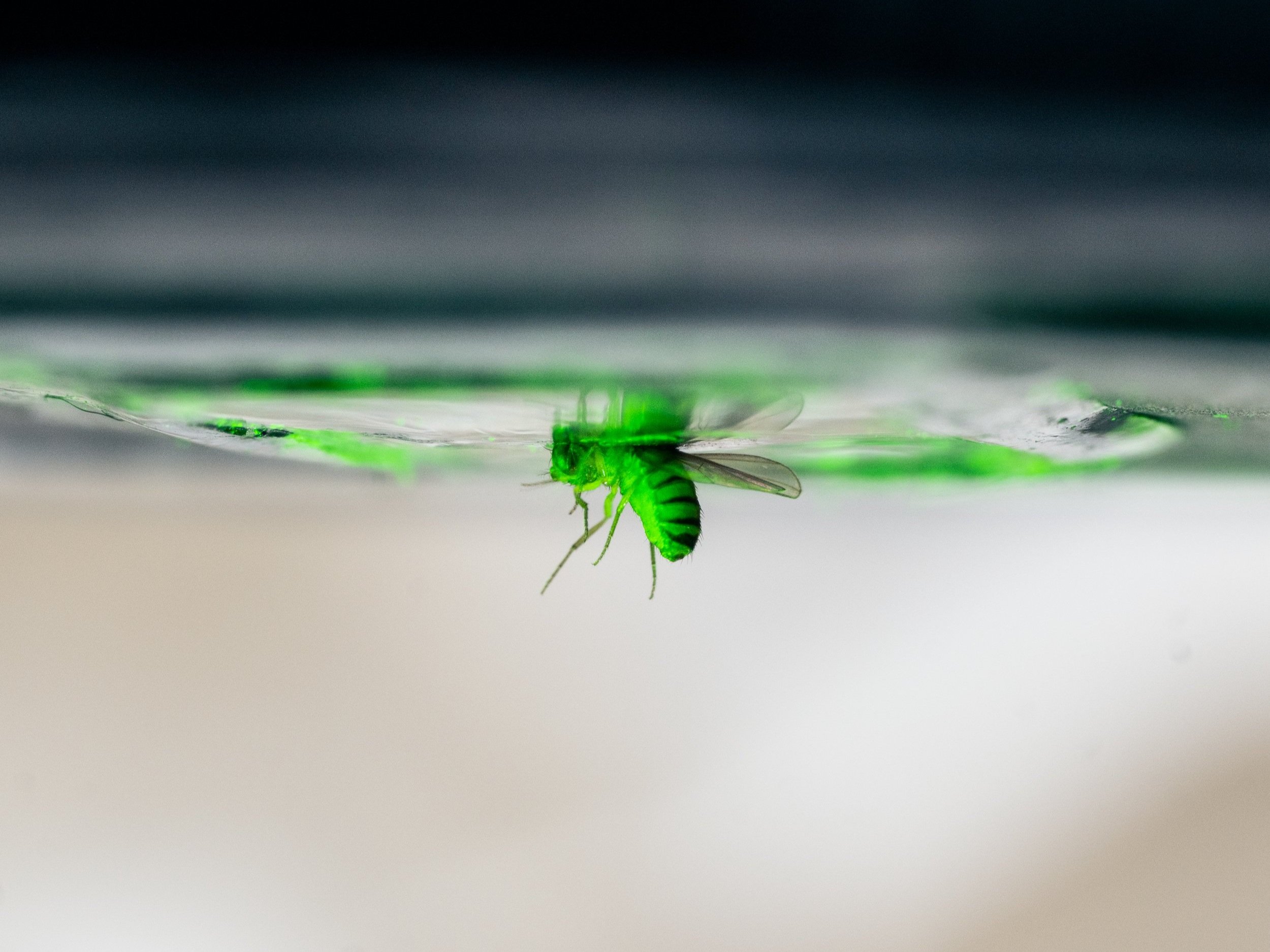
A fly under the microscope being presented with a color stimulus
Photograph by Thomas Barlow
In the Behnia Lab, we want to understand how animals choose appropriate behaviors in response to the chaotic and dynamic world they live in. Behavior results from the activity of neuronal ensembles in the brain, which interpret information from sensory receptors to select appropriate motor actions. But the structure of neuronal circuits which interpret sensory information and how these circuits drive specific behavior is relatively unknown.
In this context, we focus on how sensory information is encoded within the brain. We ask how computations used for encoding information are implemented at the cellular and circuit level and how different cell types implement the algorithms necessary for circuit function. We are also interested in understanding how these sensory circuits are modulated by internal states such as motivation and attention.
The Drosophila visual system is a perfect model for investigating these questions. The fly brain is complex yet compact. With about 1,000 times fewer neurons than mice and 1,000,000 times fewer than humans, the fly brain presents us with the opportunity to research neuronal properties at a much higher resolution. The fruit fly is also capable of many sophisticated, visually-guided behaviors, providing us with a ‘read-out’ of the system. This, combined with the availability of a large set of genetic tools to manipulate neuronal function makes it an ideal system for studying the circuits underlying sensory processing.